From Science to Action: How Engagement in Community and Citizen Science Research Can Lead to Science Activism
Prepared by: Kevin Cuff, Sarah Olsen, Matthew A. Cannady, Aujaneè Young, Alex Sanchez, Jim Neiss-Cortez, & Colleen Sutherland
Introduction
This brief presents findings unearthed through implementation of a project recently supported by the
National Science Foundation, entitled Urban Youth Participation in Community and Citizen Science.
The project's primary goal has been to explore educational and developmental outcomes associated with
engaging urban youth in informal environmental science education programming that features Community and
Citizen Science (CCS) research activities. In doing so the project has been investigating the manner in
which CCS research activity components impact youth “Science Orientation,” defined as a combination of constructs
that include: Science Identity (i.e., sense of themselves as science thinkers), Science Value (i.e.,
awareness of the potential benefits of applying scientific practices to addressing critical community health
and environmental issues) and Science Competency (i.e., belief of themselves as competent science
practitioners). The project also has been exploring how these constructs relate to one another, as well as
the relationship between emerging science orientation and the development of “Science Activism Mindset,” which is
conceptualized as a combination of constructs that include: Perceived Behavioral Control (i.e., perceptions
of their ability to use science to make a difference), Personal Salience (i.e., the extent to which youth
attach meaning to a particular issue), and Critical Consciousness (i.e., awareness of societal challenges
along with an understanding of the skills necessary to intervene).
Another goal of the project has been to implement its CCS - focused intervention programming model in three,
separate cities, and to examine differences in outcomes associated with the various iterations. To
accomplish this, project programming was presented to urban middle and high school aged youth in the East
San Francisco Bay Area, CA, Chelsea, Massachusetts, and Flint, Michigan.
The project has used a mixed-methods approach to examine the impact of program participation, utilizing
previously vetted retrospective pre/post surveys and interviews with a subset of participants to explore
their experiences in more detail. Preliminary analysis of data derived from this study clearly indicates
that the project's CCS - focused programming enhances participants' confidence in using science for positive
change, increases the value they place on science in relation to their personal lives and community, and
strengthens their identification with science, particularly in leveraging it for community benefit.
Program Overview
Project Intervention Model
The intervention model employed in the study has been structured as a 30-hour program delivered in two
primary formats:
Saturday Sessions: Meeting for five hours over six successive Saturdays at local high schools or
community centers.
Summer Programs: Concentrated three-hour daily sessions held over a two-week period.
In each version of programming, youth participate in a sequence of activities that transition from historical
and health-related framing to active scientific inquiry. They learn about connections between environmental
issues and historical factors (such as lead paint and redlining), develop skills related to testing samples
to determine the presence of heavy metals, and ultimately collect, analyze, and present data to their
communities. The experience culminates in a "call to action," where students use their findings to advocate
for local change.
Rationale
The intervention model that lies at the heart of this study was designed by staff affiliated with the East
Bay Academy for Young Scientists (EBAYS), a science, technology, engineering, and mathematics (STEM)
education research and development group at The Lawrence Hall of Science. EBAYS has a long track record of
designing and implementing highly effective STEM intervention programming that specifically addresses the
needs of youth who reside in resource-constrained Bay Area communities with large numbers of Latinx, African
American, Indigenous Central American and Asian/Native Pacific Islander families. Unlike common STEM
education programs that offer experiences quite distinct from their lived experiences (Nasir & Vakil, 2017),
EBAYS - designed programming provides opportunities for youth from these communities to engage in authentic
scientific research that directly addresses environmental health problems impacting their lives along with
those of their families and fellow community members. In the process, this programming intentionally
highlights the social and environmental justice dimensions of youth scientific research, which enables them
to develop a greater understanding of the potential benefits of using scientific practices as tools for
overall community growth and development.
An important goal of this programming is to provide positive learning experiences that afford ample
accommodation for different learning styles and cultural perspectives, offer cooperative learning
opportunities, and to address relevant, local environmental and social justice concerns. By including
activities that have such an intersectional nature, the programming positions STEM as socially meaningful
and culturally sustaining. As such, the programming helps demystify STEM content that may have intimidated
participants during their previous educational experiences (Bang & Medin, 2010; Gutstein and Peterson, 2005;
Martin, 2013; Vakil et al., 2016; Nasir & Vakil, 2017). In accomplishing these outcomes, the programming
relies heavily on its effective engagement of participants in community-based environmental quality research
projects that include the collection, analysis and interpretation, and presentation of data derived from
their studies. To ensure that these studies encourage and maintain high levels of interest, research
projects are specifically designed to address pressing, relevant community health and development concerns,
which enables participants to more readily connect their learning to lived experiences. In addition,
activities directly link community issues with broader environmental and social justice themes and emphasize
the importance of participants' contributions to community development through their data collection
efforts.
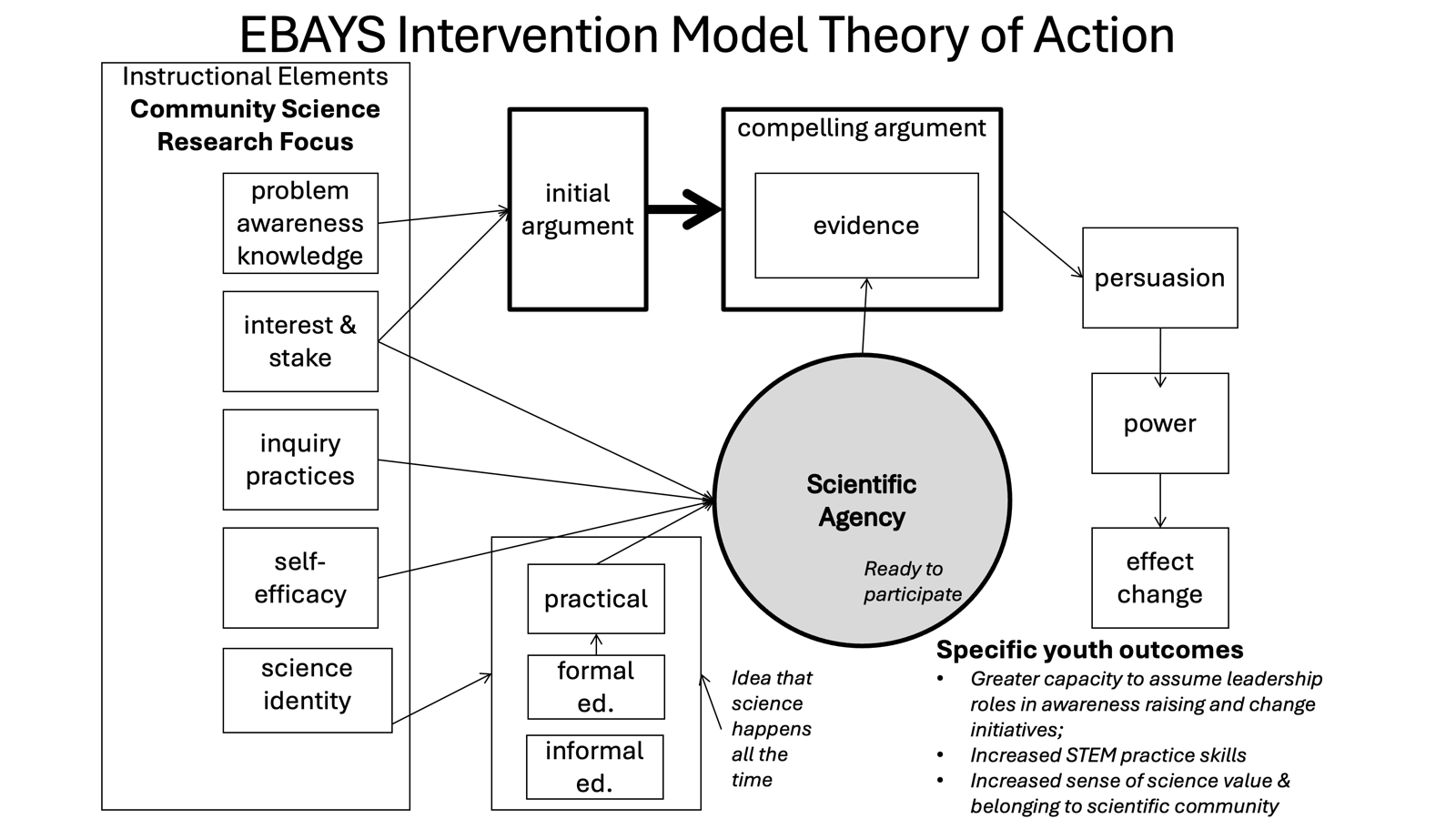
Figure 1: EBAYS Intervention Model Theory of Action
The Learning Experience
STEM Content
In each setting where the intervention model was implemented youth engaged in a combination of
inquiry-oriented framing activities and community science research activities.
Framing activities provided a combined STEM content and community relevance framework for the
community science research investigations that youth later conduct, address the following topics
(among others):
Introduction to Systems
Qualitative vs Quantitative Observations
Investigation Design
Introduction to Mapping
Use of Spreadsheets
Introduction to Lead: Occurrence, Exposure Pathways, and Related Health Effects
Local Socioeconomic Factors Impacting Environmental Degradation
CCS research activities were included to provide opportunities for participants to hone important
science practice skills as they engage in environmental quality research studies within local
communities under the suggestion and guidance of professional scientists and program staff.
Engagement in an initial set of activities familiarized participants with the use of professional
grade instrumentation and tools. Following this, participants used appropriate research equipment
and computer software to collect, analyze, interpret, and graphically represent data generated
through their research. Later they created PowerPoint slide presentations and/or posters that
illustrated their work, which then were shared with public audiences at town hall style and other
community forums. Following their initial exposure to research instrumentation, protocol, and
efficient project execution, participants discussed, designed for, and implemented other research
projects that they believed were important.
The focus of CCS research was on assessing the incidence of lead (Pb) contamination of soils obtained in
each community. Human exposure to high concentrations of Pb is associated with a variety of health
maladies, including neurological damage linked to a variety of learning and behavior-related problems.
Given that they are experiencing rapid growth of their neurological and other physiological systems,
children are especially vulnerable to damage caused by Pb exposure. Results presented in a variety of
published studies suggest that the vast majority of mobilized lead in home interiors where children
spend the majority of their time is derived from exterior sources (Sturges and Harrison,1985; Laidlaw et
al., 2005; Clark et al., 2008) such as soils. Soils in many urban communities in the United States and
internationally have been contaminated by legacy Pb derived from its past inclusion in paint used to
cover surfaces of homes and other buildings, its use as an additive in gasoline, as well as that
remaining as a result of past battery recycling and other industrial activities. Prior research also has
shown direct correlations between soil Pb and blood Pb levels in children (Zahran et al., 2013) and that
children living in inner city urban areas, whether they live in public or private housing, have a 30%
higher incidence of Pb exposure than those living in more affluent areas (Mielke et al., 2013).
Moreover, previous city-wide studies have shown that neighborhood-scale regions of high soil Pb are
associated with older housing stock (Laidlaw and Filippelli, 2008), which then act as a reservoir of
highly bio accessible Pb (Laidlaw et al., 2016; Mielke et al., 2013; Zahran et al., 2013).
Given the very high density of old housing stock (i.e., houses built before 1978) especially in
resource-challenged sections of Chelsea, Flint, and Oakland, it was expected that youth-led soil Pb
concentration studies would yield extremely useful information. In conducting this research, youth
collected soil samples from residences and public spaces and used portable chemical analysis equipment
(XRF analyzers) to determine lead concentration levels in collected samples. Results obtained in this
manner then were analyzed, interpreted, and used to create maps useful in identifying areas with severe
lead contamination. All the investigations generated high-quality data that was shared in public
presentations during which youth presented their research findings to families, interested community
members, community-based environmental justice advocates, and/or local policymakers.
Implementation
In the context of the current study, EBAYS - designed intervention programming included participation of
urban middle and high school age youth in the East San Francisco Bay Area, CA, Chelsea, Massachusetts,
and Flint, Michigan. At each location programming was presented in conjunction with local non-profit,
youth serving organizations that played a key role in recruiting youth participants and provided space
for implementation. At each site, programming was presented in either of two settings: 1) as a key
component of 30-hour long program that met over a 5-hour period on 6 successive Saturdays at local
community centers or high schools, and 2) as 30-hour long summer programs that occurred during a 3-hour
period over a 2-week period at community centers or high schools.
Evidence of Programming Impacts
Study Overview
The study employed a triangulation design approach by independently analyzing survey and interview data
and then collectively interpreting the results to explore the impacts of the program (Creswell & Plano
Clark, 2017). Survey data were collected on the last day of the program. Each program participant who
agreed to participate in the research study was administered a survey. Survey responses completed to
less than 50% of the survey were excluded from analysis. The surveys asked respondents to report both
how they felt now and how they felt before the program experience. These responses were then converted
to scale scores for participants and a mean across all participants for the “before” and “now” responses
were calculated. A paired samples t-test was conducted to compare the pre scores to the post scores.
Qualitative data were derived from structured individual interviews with participants after the last day
of their program experience. The protocol for interviews was devised by the research team and conducted
with two or three participants from each cohort (9 total). The interviews were audio-recorded and
transcribed. The transcripts were then coded by theme to identify scientific orientation and activist
mindset.
Survey Measures
Science Orientation: One's capacities to engage in science education and practice and
leverage those experiences in the classroom and beyond. a combination of constructs that include Science
Identity (i.e., sense of themselves as science thinkers), Science Competency (i.e., belief of themselves
as competent science practitioners), and Science Value (i.e., awareness of the potential benefits of
applying scientific practices to addressing critical community health and environmental issues). The
Science Orientation Constructs (table 1) were measured with previously validated scales, drawn from the
work of the Science Activation Lab (Dorph et al., 2016).
Activism Orientation: The skills and dispositions that aim for positive social change
achievable through the use of science practices, research, and/or communication. In this sense, science
is leveraged as a powerful tool to advance social well-being and to address specific societal or
community-based problems of injustice or inequality. We envision Activism Orientation to be composed of
the following constructs: Personal Salience, Critical Consciousness, and Perceived Behavioral Control.
The Activism Orientation Constructs (table 1) were measured with scales developed by the project team to
align with the program, establishing content validity through consultation with the staff and leadership
of the program.
Table 1. Overview of Constructs for the Impact Study
Table 1. Overview of Constructs for the Impact Study
Construct
Construct Definition
Science Orientation
Competency Beliefs
The extent to which individuals believe that they are good at science functions and tasks in
science settings.
Science Values
The degree to which learners value science, including the knowledge learned in science, the
ways of reasoning used in science, and the role that science plays in their everyday lives.
Science Identity
A view of self and perception of how one is seen by others as a "science person" in a given
context
Activism Orientation
Personal Salience
Students' perceptions of the personal relevance, need for action, personal interest, and
sense of responsibility in regards to environmental justice issues
Perceived Behavioral Control
One's perceptions of their ability to use science to make a difference and one's evaluation
of whether they can have an impact on a science-related social issue - which may include
their perceived access to systems, people, and resources, as well as their perceptions of
the manageability of the problem.
Critical Consciousness
Critical consciousness combines awareness of disparities and inequity with the agency to
take action.
Study Participants
Study participants were drawn from three locations, the East Bay area of California, Flint Michigan, and
Chelsea Massachusetts. Table 2 below details the demographics of participants across locations. The vast
majority of participants were from California (156), there were more girls/women than boys/men or other
gender identities. And the largest racial/ethnic identities across the sample were Black or African
American (25), East Asian (32), Latinx/Latine/Latin@ (32), and White (29).
Table 2. Survey Participant Demographic Information by Location
Table 2. Survey Participant Demographic Information by Location
Demographic category
California
Michigan
Massachusetts
Gender
Girl/Woman
80
13
22
Boy/Man
60
4
12
Trans, gender non-conforming, non-binary, two-spirit, agender, questioning, prefer not to
answer
16
3
0
Total
156
20
34
Race/Ethnicity
Black or African-American
11
8
6
East Asian
31
0
1
First Peoples/Native American/Alaska Native
2
0
2
Latinx/Latine/Latin@
21
0
11
Middle Eastern and North African (MENA)
5
0
0
Native Hawaiian or Pacific Islander
2
0
0
South Asian
7
0
4
Southeast Asian
8
0
0
White
26
2
1
Not sure/prefer not to answer
4
2
2
Total
96
10
23
Note. Not all surveys included both gender and race/ethnicity. Students could select more than one
race/ethnicity.
Findings
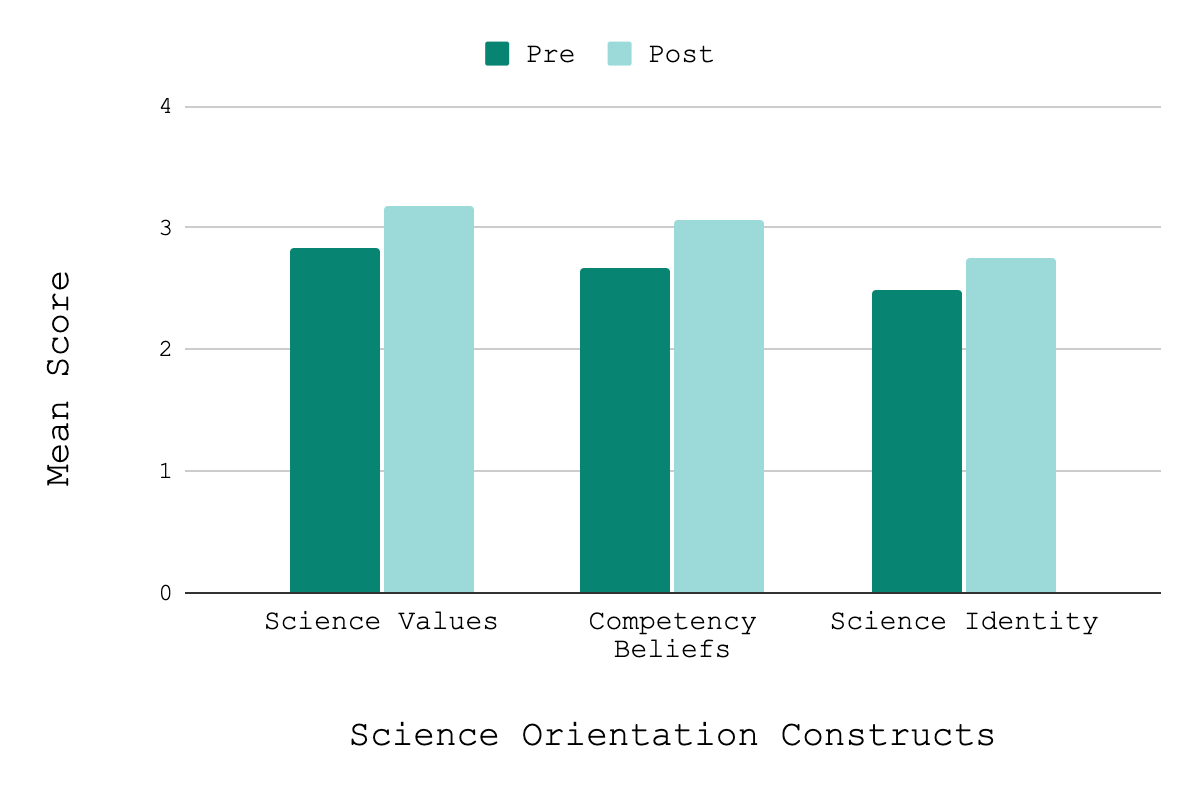
Looking at survey responses for the science orientation constructs (Figure 2), Science Values, Competency
Beliefs, and Science Identity we see increases in the mean score across all of these from pre to post.
Figure 2: Mean Retro-Pre and Post Scores for Science Orientation Constructs across participants.
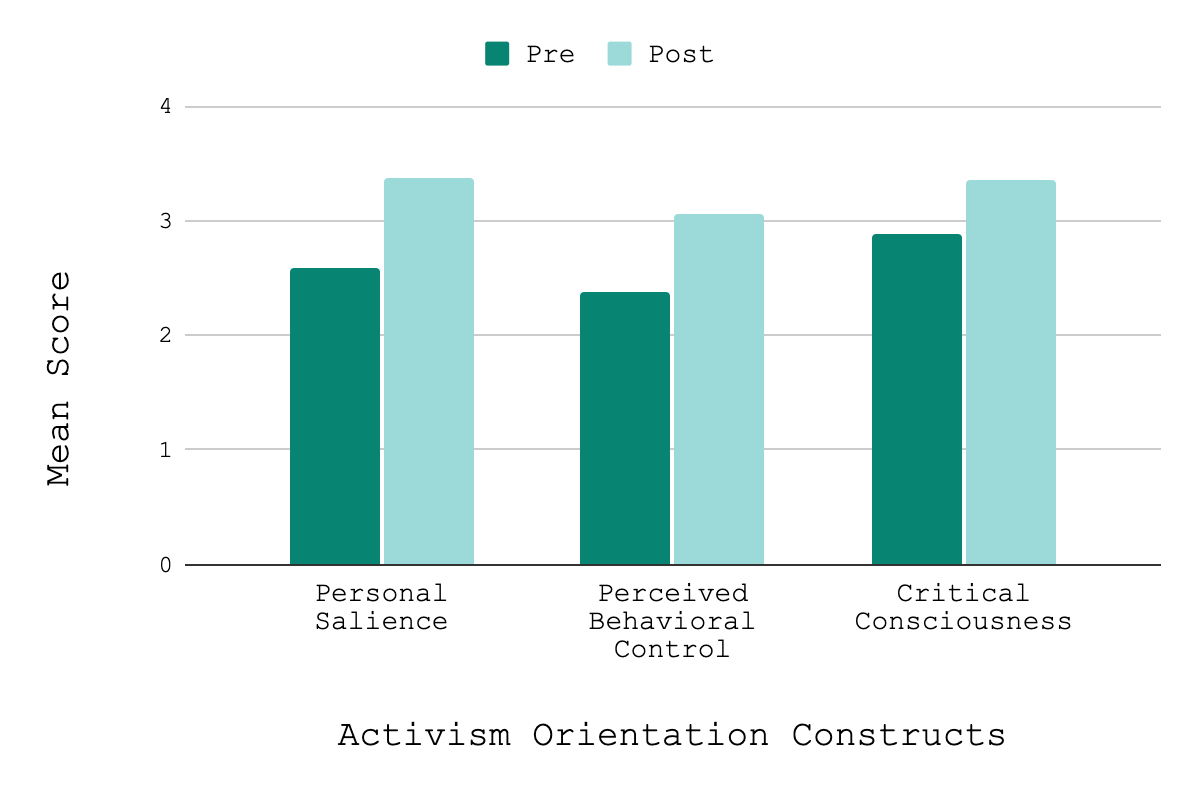
We see a similar pattern in responses for the survey scales associated with Activism Orientation,
personal salience, perceived behavioral control, and critical consciousness (Figure 3). All three scales
see an increase in mean scores between pre and post.
Figure 3: Mean Retro-Pre and Post Scores for Activism Orientation Constructs across
participants.
Below in Table 2 we can see that the differences between pre and post means are statistically significant
across all scales. This means that on average participants in this program increased across all scales,
implying that the program facilitated increased their science and activism orientation, or what we would
call a science activism mindset.
Table 2. Mean Scale Score T-test Findings.
Table 3. Mean Scale Score T-test Findings.
Scale
n
Mean Pre
SD
Mean Post
SD
Mean Dif.
SD
sig.
Effect size
Science Values
184
2.84
0.45
3.17
0.45
-0.33
0.35
<.05
0.96
Competency Beliefs
206
2.66
0.49
3.06
0.47
-0.41
0.36
<.05
1.13
Science Identity
204
2.49
0.72
2.75
0.72
-0.25
0.36
<.05
0.72
Personal Salience
144
2.59
0.6
3.38
0.61
-0.8
0.61
<.05
1.32
Perceived Behavioral Control
142
2.38
0.6
3.06
0.63
-0.68
0.52
<.05
1.31
Critical Consciousness
139
2.89
0.58
3.36
0.53
-0.48
0.43
<.05
1.11
To further demonstrate how this community-based scientific research program can expand youth's connection
to science and their community through building a science activist, we draw on statements from
participants. For example, one participant described how their consciousness of these issues had been
raised
I didn't realize how important [lead poisoning] was until the program. Because they talked about
[how] it affected children… I think it's really important just because it has a super huge
effect on children and adults. And I think it needs to be sort of talked about more after this.
- Recent Participant.
Others recognized the importance of the connection to community, that because this issue is something
that impacts where they live, it is more important for them to be aware and to do something about it.
It brings it a little closer because sometimes when you don't really learn about something, it
can seem a lot farther away, but we're learning about it in the community, so it feels a lot
more real. -Recent Participant
I felt like I had fostered a better community by being in the program. It's realizing my actions
can help so many people out. And it's in a way important for us to try to realize we're all
connected together in some way…our actions can…help other people out in a lot of ways like
directly within all the communities that we're in. -Alumni
Other participants stated that simply knowing about heavy metal in the soil and the health impacts that
they can cause was not enough. They recognized the importance of science in making the argument and how
they themselves want to contribute to solutions.
I think it kind of helped reinforce that you need like data to backup your evidence...the premise
of the flyer was educate people in the area about the high lead concentrations, but obviously
that would not have really worked as well without the actual map of the lead concentrations.
-Recent Participant
I think that's when I first learned about how much things can impact a community…from there I
learned about how lead can impact communities and how severe the effects are. I didn't know that
stuff existed and then this actually led me to getting another internship about environmental
justice. -Alumni
Another example of the impact the program can have is on the alumni that have participated. Through the
alumni interviews, we heard several stories of how the program contributed to their commitment to making
a difference for their communities. For example, one alumni from the 2021 cohort described how her
participation in EBAYS programming contributed to her decision to major in Natural Resources and her
desire to pursue journalism with an environmental justice lens. Another alumni reported how they used
their knowledge about lead regulations derived from EBAYS programming to obtain an internship position.
They also earned their real estate license to help low-income communities know more about the impact of
redlining on housing and housing access.
Summary of Impacts
Community-based, justice-oriented science learning transforms the traditional classroom experience by
grounding scientific concepts in local histories, community perspectives, and shared resources. By
making content deeply relevant to learners' everyday lives, this approach does more than just prepare
students for future academic success; it actively positions them to leverage science as a catalyst for
driving positive change in their own neighborhoods. Ultimately, by fostering a justice-oriented and
interdisciplinary mindset, this model breaks down traditional barriers to entry, making science more
inclusive, accessible, and meaningful for everyone.
Conclusion
Community-embedded environmental research projects like those presented by EBAYS are critical to
addressing environmental problems exacerbated by societal decisions. Raising awareness directly within
the communities through the active involvement of the community in the research is critical for creating
meaningful change, in both behaviors of the community and in the eventual clean up of the persistent
issues.
As demonstrated in this brief, by engaging in such research participants become more aware of the ability
of science to be marshalled for social change. Furthermore, through participation in the project's
programming youth recognize the relevance of some of the subject matter they are exposed to in school to
their lived experience and greater community, and that they can be catalysts for change. These results
have been consistent across educators, cohorts, locations, and communities. The programs have varied in
their implementation across these sites, yet participants consistently are more aware of their role in
making change for their communities and begin to see themselves as an agent of change through science
activism.
Given the demonstrated positive educational and developmental impact that its activities have had on
participants, implementation of the project has generated evidence in support of the notion that
inclusion of CCS research activities can be of tremendous benefit to future urban-based formal and
informal STEM education reform efforts. Furthermore, project findings illustrate the usefulness of
developing approaches for advancing STEM literacy that are sustained by combining university-related
assets with those of community-based organizations. Additionally, through its implementation the project
also has demonstrated how its programming model can play a role in helping to address urgent regional
and national needs including: (1) increasing public STEM understanding and career awareness; (2)
increasing public participation in environmental monitoring and other STEM-related research activities;
and (3) identification of previously undetected, highly toxic environmental conditions.
How to Get Involved
The Issue of soil heavy metal contamination is pervasive in urban cores throughout the US due to the use
of lead paint in older homes, vehicle emissions, and historical use of pesticides/herbicides. The
program described here can be helpful in drawing attention to and addressing related issues in
communities around the country. The Lawrence Hall of Science offers several curriculum models that are
available to implement within local communities. To learn more about how to bring these to your own
community please visit our `website www.lawrencehallofscience.org.
Acknowledgements
We want to acknowledge the incredible efforts of our partners in Michigan and Massachusetts,
specifically the Flint Neighborhood Engagement Hub and the Harvard University Museum of Natural History.
Your ability to translate this locally incubated program into such a powerful localized experience is
greatly appreciated.
References
Bang, M., & Medin, D. (2010). Cultural processes in science education: Supporting the navigation of
multiple epistemologies. Science Education, 94(6), 1008-1026.
Clark, H. F., Hausladen, D. M., & Brabander, D. J. (2008). Urban gardens: Lead exposure, recontamination
mechanisms, and implications for remediation design. Environmental Research, 107(3), 312-319.
Creswell, J. W., & Plano Clark, V. L. (2017). Designing and conducting mixed methods research (3rd ed.).
SAGE Publications.
Dorph, R., Cannady, M. A., & Schunn, C. D. (2016). How science learning activation enables success for
youth in science learning experiences. The Electronic Journal for Research in Science & Mathematics
Education, 20(8).
Gutstein, E., & Peterson, B. (Eds.). (2005). Rethinking mathematics: Teaching social justice by the
numbers. Rethinking Schools.
Laidlaw, M. A. S., Mielke, H. W., Filippelli, G. M., Johnson, D. L., & Gonzales, C. R. (2005).
Seasonality and children's blood lead levels: Developing a predictive model using climatic variables and
blood lead data from Indianapolis, Indiana, Syracuse, New York, and New Orleans, Louisiana (USA).
Environmental Health Perspectives, 113(6), 793-800.
Laidlaw, M. A. S., & Filippelli, G. M. (2008). Resuspension of urban soils as a persistent source of lead
poisoning in children: A review and new directions. Applied Geochemistry, 23(8), 2021-2039.
Laidlaw, M. A. S., Filippelli, G. M., Brown, S., Paz-Ferreiro, J., Reichman, S. M., Netherway, P., ... &
Mielke, H. W. (2016). Case studies and evidence-based approaches to addressing urban soil lead
contamination. Applied Geochemistry.
Martin, D. B. (2013). Race, racial projects, and mathematics education. Journal for Research in
Mathematics Education, 44(1), 316-333.
Mielke, H.W., Gonzales, C.R., Powell, E.T. and Mielke, P.W., 2013. Environmental and health disparities
in residential communities of New Orleans: The need for soil lead intervention to advance primary
prevention. Environment international, 51, pp.73-81.
Nasir, N.I.S. and Vakil, S., 2017. STEM-focused academies in urban schools: Tensions and possibilities.
Journal of the Learning Sciences, 26(3), pp.376-406.
Sturges, W.T. and Harrison, R.M., 1985. An assessment of the contribution from paint flakes to the lead
content of some street and household dusts. Science of the total environment, 44(3), pp.225-234.
Vakil, S., McKinney de Royston, M., Suad Nasir, N., & Keighes, N. (2016). Rethinking race and power in
design-based research: Reflections from the field. Cognition and Instruction, 34(3), 194-209.
Zahran, S., Mielke, H.W., McElmurry, S.P., Filippelli, G.M., Laidlaw, M.A. and Taylor, M.P., 2013.
Determining the relative importance of soil sample locations to predict risk of child lead exposure.
Environment International, 60, pp.7-14.